Showing posts with label Gear. Show all posts

November 24, 2014

What does #gaitanalysis mean to you?


A_King_CMYK_page_001.1.151b89547eb4c

What does this name mean to you?

For a number of years now, Amphibian King has been building a reputation as THE place to go to buy your running shoes.

All of the staff in all of the stores (Bray, Ballymount & Galway ) are very keen runners or triathletes of some distance or another. We all share the same desire as you to train and race injury free. All year round.

So allow me to tell you how we do it....

Firstly, we know 'run'. We know what running does to the body and we are aware of how the body works. So we understand, you.

Secondly, we know 'shoes'. We get regular tech sessions with the running brands so, yes, we understand their shoes better than most. At the same time we all are interested in the 'what' and the 'how' of footwear or not. We are all keenly interested in running with or without shoes. This is important so we understand what makes you tick.

When you come to Amphibian King what should you expect?
When you come in to be fitted for your runners, whether you are starting out or running marathons daily, young or old, the first thing we do is NOT talk about shoes.

We want to know you, we want to know what you are doing; running, walking, track, road, trail etc. how you are doing it, your injury history (if any), your running goals for the next 6 months. All to help build a picture.

We will look at a heat scan of your arches, are you flatfooted? high arched? off balance? While looking at your feet we also measure them.

I've discussed shoe size before so we are looking at barefoot, shoe size & running shoe size. Ultimately the running shoe size is determined by the answers to the questions:
we want to know what you are doing; running, walking, track, road, trail etc. how you are doing it, your injury history (if any), your running goals for the next 6 months
We then use our eyes to watch you running. We use video capture to allow us to review your stride in slow motion. Are you neutral? Do you over pronate? How much over pronation? Are you supinating? Left foot / right foot? Lots of little clues that allow us to help you decide what category of footwear will work for you. Very often you will see these clues yourself and we love when customers get involved.


Now we know you, your feet and your running. Time to talk shoes!!

Your personal advisor will now take you through a series of footwear choices, looking at you running on the track and they will then explain what shoes you should be wearing, why they suit you and what makes those shoes right for you. Finally you get to try some on!! :-)

Again you will be doing more running, testing the shoes out, we'll check the technical bit on the camera again. But now you are fully focussed on how the shoe fits, feels, responds, reacts when you run it it.

The most important thing for us is that you make the right choices. We don't want to see you sidelined with injury. We want to see you out running. We don't want wrong footwear stopping you from doing what you love doing. This is why so many people trust us with their footwear selection. Check out the Reviews on our facebook pages.

If you have been into Amphibian King, we'd love if you would help share the experience. Did we fulfill your needs?

If you haven't been in, we'd love it if you would give us a go, trust us, to help you.

 Keep on running!
Know what your customers want most and what your company does best. Focus on where those two meet. ~ Kevin Stirtz

October 1, 2014

#DublinMarathon Panic Stations

Ok I posted this in jest (kind of) earlier on Facebook, but this is a serious matter.


If you are training for +Dublin Marathon and have not replaced your shoes since you started your training program 9 out of 10 times your footwear is not going to get you to the start line.

There is still 200miles worth of running to be done before that medal is hung around your neck.

Don't leave it to chance, now is the time to change your shoes so you can have them well run in before the big day.


In fairness to the Dublin Marathon organisers they have been on top of the lastminute.com entries and given plenty of warning throughout the day, including this clever "significance of 2:02:57" *tips hat* to the recent World Record in +Berlin Marathon :


Then following up an hour later with:


Well done to everyone on the media team. 

Tell us did you get your entry in in time?

September 15, 2014

Do you do the lift thing for the foot?

Not sure why people are being conditioned to think that you have to have arch support in running shoes but it is a simple fact of life that there is an escalating trend of customers presenting themselves to me in +Amphibian King West - Galway either with or looking for arch support.

arch1
ɑːtʃ/
noun
noun: arch; plural noun: arches
1.
a curved symmetrical structure spanning an opening and typically supporting the weight of a bridge, roof, or wall above it.
synonyms:archway, vault, span, dome;
bridge
"a stone arch was built at the entrance"

January 29, 2014

Motion in Moderation - Motivation through Activity

At this time of year you can't move without #OperationTransformation, #BiggestLoser type programs on TV and all across the internet information on weight loss, best diet to follow and all kinds of spurious advice.

A lot of these programs and diets are 'quick fixes'. Feel good for a while, lose some weight but then the old habits slip back in slowly but surely and all that hard work goes out the window.

For many people simply being a little bit more active and being a little bit more conscious of their food (intake and quality) is enough to achieve personal goals that will be of benefit to your health in the long term.

As a child, did you have one of these?

http://www.amphibiankinggalway.ie/#!polar-loop/c12ax


It was a way of recording what you were doing and rewarding you for results.

Every fridge had one and the sense of achievement when you got that new toy, or treat or trip to the zoo was like magic.

Are you ready for the grown up version?

Exclusive to Amphibian King West.... we bring you

Polar Loop


Polar Loop is an Activity Tracker use it to:
 

Track your activity

Climb the stairs. Ride the waves. Jump over the fence. Choose what makes you move.

Polar Loop tracks all the choices you make during the day and shows how they’re good for you. It also reminds you when you’ve been still for too long.

Reach your daily goal

Check your bracelet or mobile to see how much you’re missing from your daily activity goal to continue feeling good.

Follow your achievements

Living an active life has never been this fun and easy.

Check the Polar Flow web service and learn how all your small choices and daily habits can make a world of difference.

The smart Activity Guide gives you tips on how to get there.
With obesity being such a problem for a whole series of generations, the #PolarLoop is a perfect inobtrusive activity tracker for young and old. 
You might not want to know how long you are sitting during the day, but what if you did know? If you realised you are sitting for 60% of your waking day, what would you change about your activities?
What happens if you are eating 3000kcal daily and your activity only burns 1000kcal? Reduce one and increase the other and your body will thank you.

Whether it is step counting, calorie burn or weight loss an Activity Tracker is the way to monitor and reward yourself. 


Go on give it a try!! The first delivery of Polar Loop is hitting the shelves in Amphibian King Galway and LImerick only (this is not available anywhere else in Ireland until March) if you want to change how your day progresses, you need to move a little quicker and get a Loop!!

November 21, 2013

What to wear for #running today?

I'm regularly asked advice on "what #running gear do I need for this weather?" The question pops up on +Twitter, +Facebook, Boards, Google+, you name it, I even get asked in +Amphibian King West the odd time!  :)


I usually throw out a few suggestions; "one of these", "some of those" and "if its doing this, wear that".

I realised yesterday possibly the best way to answer this is to do a show & tell. So starting today I'm going to show you how I dress for different weather conditions.


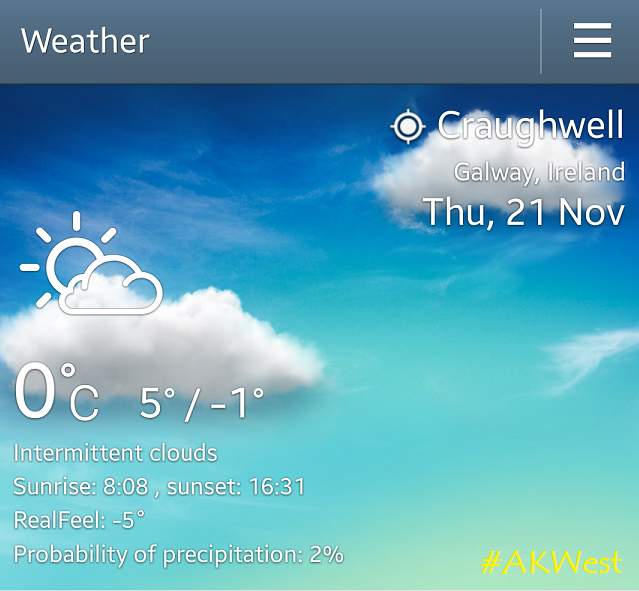
November 21st - Cold, dry 92% chance of precipitation) and with a 'RealFeel' of -5°c (I presume some form of air wind chill guesstimate).

Now, I don't check my phone to see how to dress. I was out at the bins and the foggy breath and snap to the air told me enough.

This one is easy to address:
Those tags in the image may not be clear enough, so.

Hat - a 7 year old promotional beanie from +Polar that everyone wants to buy from me. No way, never!! 
Neck scarf - buff type from Amphibia Sport. Perfect to keep the headphone cables from flapping around, and my chin nice and warm. 
Upper body - Outer shell is a +Saucony Kinvara Nomad Jacket over an inner layer comprising of a long sleeve thermal top. 

Aesthetic FlexFilm details make our Kinvara Nomad Jacket a pack leader, while the windproof front panel, thermo-regulating sleeves and side panels, and the ultra-breathable fleece back vent make runs in any weather a breeze! 
Lower body - Saucony Omni tights with a NGOI base layer (to prevent brass monkeys) keep the leg muscles warm and cosy.
NGOI Base layer shorts.  


The main issue is the windchill factor. You are still sweating in the winter time and clothing that prevents the wind passing through will stop your trunk from getting cold. If your torso gets chilled you are going to be miserable in no time at all.

So, dry weather but cold: thermal base layers, windproof top or jacket, hat, gloves (off for positioning camera), long leg tights.

That's how I dress today.

November 11, 2013

#GearTip for Winter Training

With the Winter really on top of us now going #running requires a little thought and preparation to ensure that you are comfortable in all sorts of weather conditions.

Two items of gear which are invaluable in my book are:


Designed as a trail running tight, the material in the +ASICS Fuji Trail tight is stretchy and comfortable. The designers made the lower leg material slightly thicker and durable to help prevent tears and pulls when running through rough vegetation.

I find this lower leg material is water repellant and as a result keeps your legs dry when running on wet roads. The splash water is not absorbed by the fabric and you get no water creep on longer runs.

Perfect item for road or trail running in the wet.

ASICS Fuji Trail tight

Second piece of 'can't do without' equipment is a fabric tube from +Amphibia Sport.

Lots of different uses from scarf to sweatband. Personally I find the best winter use is as a neck scarf. Bunch the material up, pass over your head and its sits snug around your throat, keeping your neck warm, zip your jacket up and the scarf prevents rain from running down the back of your neck.
 
Amphibia Sport - fabric tube

October 29, 2013

#FindYourStrong - Let Saucony be your Guide

The +Saucony Guide 7 is arriving soon into +Amphibian King West and +Amphibian King stores through out the country. We can't wait to get out feet into this new version of the award winning shoe.

Stay tuned for more news.


October 16, 2013

ASICS Running Backpack


I love getting new #running kit to try out.

Recently in +Amphibian King West I was handed an +ASICS  running backpack to see what I thought of it. I don't normally run with a backpack but in the winter time as I use a  Silva headlamp with a separate battery pack I do find a backpack handy for carrying the batteries and other bits & pieces.

Immediately I liked the colour and appearance of the bag. Great reflectivity and strong flourescent colours ensure visibility from the rear. As you can see in the picture (taken with a phone flash) it stands out against a dark background no problem.

There are dual compartments in the bag. The inner one is for a hydration pack (not provided with this bag) and an outer compartment for gear.

Both compartments are zipped and then there are 2 small pockets on the hip panel of the bag which I found handy for my GPS receiver and some +GU Energy Labs Chomps for the longer runs. They stayed in the pockets and were easy to access.

There is an outer compartment with a cinch type belt clip on it. The compartment is open and ideal for quick stowage of a rain jacket, hat or gloves.

Regarding the fit the bag is unlike most bags I've used previously. The 'compartment' part is fitted to a 'harness' part. You fit the harness to suit you and then you can adjust the height of the backpack position on your back.
Harness adjustment is easy with the toggle belt.

Personally I found the low-slung backpack the best position of all as any weight sits on your hips and there is far less 'jiggle' with no movement on your shoulders.

The front of the harness features some bungee cord loops which are handy for fitting a water bottle to and with the harness being made of a sturdy mesh I could see myself stitching all sort of loops and appendages to it to make a complete utility pack from the harness.

All in all a great bag, I like it a lot and will be using it for a while to come.

October 2, 2013

Reflecting on Run Safely

Starting from a Twitter conversation, I reckon it's time to put some information on paper about HiVis / Reflective gear.


With daylight hours being so short now and visibility so 'grey' you as a runner / cyclist / pedestrian have to take matters of your own safety very seriously.

Place yourself in the driving seat on a winter's day, low sun reflecting off damp road, rain blurred windshield, how much can you see?

Not much, everything looks grey.

As a pedestrian if you can't be seen against this background you are in serious trouble.

Low sun, glare & rain affect visibility
This is where HiVis clothing comes into it's own. Most HiVis clothing or vests feature reflective strips and DayGlo colours. The most common example is the Vest below, commonly used by walkers and cyclists, though they can be billowly and uncomfortable for running with:
The reflective strips flash when light hits them highlighting that there is an 'object' ahead. The colour is DayGlo yellow which functions brilliantly in daytime (hence the name), every driver slows when they see a flash of yellow in the distance, but serves no function at night.

Sciency bit:
 Normal color absorbs and re-emits a portion of the visible spectrum that matches its principal wavelength, while the remaining colors are absorbed and dissipated as heat. In this way, a regular yellow color re-emits back to your eye just the narrow yellow band of the visible light spectrum. Therefore, if there is little or no yellow light around (such as early dawn or dusk) the yellow surface would appear dark or even black.
 DayGlo provides daytime visibility by ensuring you standout from your background.

We recommend for anyone running, daytime or nightime, to keep it simple and use a combination of the following:

Clothing or outerwear must be flourescent and retroreflective. Colour patches serve to break up your outline and provide contrast so that you appear as a human shape in the dark, not just some litter fluttering in a ditch.

Look at how the runner 'pops' out of this background -


Sciency bits:
Fluorescent colors use a larger amount of both the visible spectrum and the lower wavelengths compared to conventional colors. They not only absorb and convert light energy of the dominant wavelength, but also the wavelengths of ultraviolet rays and other colors lower in the visible spectrum. As a result, your eye perceives a far more intense color.
Where a clean, bright conventional color is able to reflect a maximum of 90% of a color present in the spectrum; a fluorescent color can reflect as much as 200% to 300%.
A retroreflector (sometimes called a retroflector or cataphote) is a device or surface that reflects light back to its source with a minimum of scattering.

Use a headlamp. Even if you are comfortable with where you are running and know the surface like the back of your hand, a decent headlamp will always help draw attention to your outline. Who doesn't spot a light source 5-6' off the ground and wonder what it is?
SILVA X-Trail
Use a flashing rear facing lamp. Just a small detail but very often we are focused on being seen from the front and often forget about some small details on the rear. Whether its a bicycle style rear light (red lens) attached to a backpack or a blinking light at head level it doesn't hurt to have a little bit of extra visibility.

Carry ID. A phone with ICE contact or ideally an ID bracelet should the worst ever happen.

Be defensive. Try and view yourself from a driver's perspective. What can you see? Run against traffic, behind cars at intersections, and avoid areas that might not be super safe.


September 25, 2013

Heel to Toe, what?

There is so much talk about Heel to Toe drop / differential / ramp / profile of running shoes these days that it is confusing everyone.

At the end of the day whatever is comfortable for you is the most important aspect of H/T measurements. The footwear must suit your natural running gait and that's what we are looking at here in +Amphibian King West.

I've blogged plenty before about #minimalism and you can find a lot of those articles through the labels at the bottom, just click on the word.

We'll leave the good folk at +Saucony to give you the low down (so to speak) on what Heel to Toe is all about and how it impacts you as a runner.


Heel To Toe Offset Explained from Saucony on Vimeo.

August 31, 2013

How many pairs of shoes do you need?!

If I'd a €uro for everytime I heard this remark in my house, I could buy another pair of shoes! :)

The most recent, threatened, clean-out had me thinking about it afterwards as I realised my responses were

"NO! Not those, I need them for ...."

and

"Not those either, they're my . . run shoes!"

and so on and so on.

Right now I'm in the middle of a training program for a marathon and like any sensible runner, I'm switching around and rotating my footwear on a regular basis.

As I looked at my stash of footwear I started to realise that I had a particular shoe for each and every type of run I was doing. I also noticed that, unconsciously, I was choosing footwear particularily suited to those type of runs and getting the best out of me in each session whilst (most importantly) minimizing my risks of accruing a running injury.

Currently I'm rotating through, and regularly use:

  • Mizuno Inspire 9 (just brought a 2nd pair into rotation as my existing pair are left in Sligo)

  • Brooks PureCadence

  • Saucony Fastwitch 6

  • Mizuno Elixir

  • Mizuno Sayonara

  • Brooks PureGrit

Yeah I know, it's overkill using so many shoes but the reasons for this will become aparrent when you consider what I'm doing in each shoe.

Running!

I'll deal with the straightforward ones first, explaining whats unique about each shoe in terms of cushioning, heel-to-toe ramp, stability, typical session pace.

Saucony Fastwitch 6

Saucony say - ideal for 5K - Marathon.The Fastwitch 6 features a newly designed FlexFilm upper. It's a light and stable shoe designed for the road warrior taking their race to the next level. Weight: 196gm.

fastwitch 6I use this as my race shoe and comfortably raced several half marathon distances this year in these. I believe it is imperative that whatever you use on race day have been tested out in training and I do use these for some sessions, just to stay familiar with them.

  • Cushioning - Dual Density SSL(Saucony Super Lite) EVA. An advanced EVA blend that maximizes rebound and durability while minimizing weight.

  • Heel to toe - 4mm differential

  • Medial post providing guidance for overpronators like myself.

  • Session - racing or speed intervals at <4:00min/km

Brooks PureGrit

Brooks say - When you want nothing to come between you and the trail, the ultra-light PureGrit won't get in your way. We constructed an outsole with an aggressive, multi-directional lug pattern for better grip on the ever-changing surfaces of adventure. Its concave shape delivers better balance by splaying out upon impact and creating more surface area for ground contact. With blazing colors, you'll light the trail on fire.puregritWith awesome off road grip this is my go-to trail shoe for any wet, mucky offroad runs. I've really grown to love pulling these shoes on and even achieved my half marathon PB using these in Portumna Forest this summer. (Race report loooong overdue, though I have a review of these from when I first got them earlier this year - Brooks PureGrit

  • Cushioning - BioMoGo DNA fuses BioMoGo midsole and DNA gel cushioning technology for a fully custom responsive ride that adapts to the needs of each and every runner. Toe Flex uses a toe split in the outsole/midsole materials that allows the big toe to function independently and engage the runner's natural balance during toe-off.

  • Heel to toe - 5mm differential

  • Very neutral offroad shoe. The PureGrit2 features a modified outsole which I consider is more hybrid as its designed around Green road, gravel forest trail and dusty canyon type trails rather than the sort of 'fell' or forest trails which I love.

  • Session - recovery forest runs at >5:30min/km

Mizuno Elixir Vs Mizuno Sayonara

I'm putting these two bad boys together because I use them for exactly the same thing.

Mizuno say about Wave Elixir 7 - Wave Elixir provides protection and a light cushiony feel—without the weight or bulk. The combination of Dynamotion Fit and a light-weight, responsive midsole deliver a snug fit for a great feel and fast run. Designed to evoke movement, even when standing still. The Wave Elixir 8 not only looks fast, but feels fast. All while delivering Just Enough support. Internal forefoot overlays provide superior hold and embrace at toe-off. G3 SOLE provides superior traction at a reduced weight for more confidence with every stride. AP+ midsole designed for long-lasting durability and unparalleled responsiveness. Weight 204gm.

Mizuno say about Wave Sayonara - Mizunos exciting new light training shoe featuring the new U4iC midsole that delivers an amazing cushioning to weight ratio. The Sayonara delivers mile after mile of light cushioned stable fun. Weight 190gm.

[caption id="attachment_1140" align="aligncenter" width="300"]elixir Mixuno Elixir[/caption]
The Wave Elixir became my first proper racing shoe in 2012 and I used it for everything up to half marathon racing, tempo & interval runs and planned on using them in what became my aborted Dublin Marathon 2012.

Once I got back to running in the New Year 2013 I used the Elixir more and more and my trusty Inspire less and less. Progressing with my transition to a more minimal shoe I found that I could run more repeatable distances in these shoes with no ill-effects (due to less support) and was soon able to introduce a pair of racing shoes into the mix. Apart from my Mizuno Inspire 3 & 4 the Mizuno Ellixir 7 is my favourite shoe of all time and it will take some shoe to beat it!

Roll on a few months and the Elixir 8 is being discontinued in favour of the new Mizuno Sayonara which is becoming a kind of genetically hybrid mix of the mating between the Wave Precision and the Wave Elixir range of shoes. In profile it is lower to the ground and has a slightly lower ramp height.

Now to be fair to the Sayonara, I really, really, REALLY love the fit & ride of the Elixir and possibly because I knew the Sayonara was the usurper I didn't like it. I almost didn't even have it on my foot completely and I was saying no, no, no! Edel was looking at me like I was a spoilt child about to go off and sulk. I felt like it too, I was so disappointed.

Then I ran in them.

They're like the One Direction of the running world. You love to hate them but they catch on and you find youself enjoying them against your will.

(FOR THE RECORD I AM NOT A CLOSET ONE DIRECTION FAN - BOWIE & BLONDIE ROCK!! :) )


[caption id="attachment_1139" align="aligncenter" width="300"]sayonara Mizuno Sayonara[/caption]

First up Mizuno Elixir 7

  • Cushioning - AP+ midsole providing comfort and durability. This flexible forefoot provides plenty of 'feel' for the surface and really engages the foot on propulsion.

  • Heel to toe - 13mm differential.

  • Mildly supportive medial Wave, with a low forefoot & high heel you are pitched forwards and just want to run faster and faster. The heel/toe ramp is not intrusive and this can be used for everything! Unlike some light support shoes I have no illeffects running slow or easy in these.

  • Session - speed, race, recovery, easy runs; handles everything from <4:00 to >5:30min/km

Now Mizuno Sayonara -

  • Cushioning - U4iC midsole

  • Heel to toe - 10mm differential.

  • Classed as a more neutral performance shoe but the lengthening of the Wave on the medial side provides some guidance. I think the change of the heel-to-toe  makes this more of a racing flat than the Elixir which is why I can get away with the lesser amount of support. Still easing my way into them so long term verdict still outstanding.

  • Session - tempo session <4:00 to 4:30min/km

Brooks PureCadence
Brooks say - With lean construction and a responsive fit, the PureCadence 2 rethinks how support technology is engineered. Features like the internal PDRB help prevent overpronation without added parts and the wide Nav Band holds your foot like an endless hug. Add fresh looks and some street cred, and this featherweight friend will run footloose and fancy-free with you.

pure cadence

After my relative success with the Brooks PureGrit and the comfortable transition to the 4mm Saucony Fastwitch 6 as a racer I was feeling confident about doing a little more in  a minimal shoe.

Without taking unnecessary risks I still wanted to use a shoe with a hint of medial support, a little more flexibility (but not too much) and a shallow heel to toe ramp. It also has to be comfortable, I am a big guy afterall and like my feet to be aware of whats going on but without being hammered. The Brooks PureCadence ticked all of those boxes and in no time I was off running long runs in them.


One of my most memorable runs this year was in Lanzarote when I took on this:

 IMG_1650

Probably better suited to my PureGrit but I was travelling with just one pair of shoes (Ryanair) so they had to count for everything.

The view from the top was spectacular


IMG_1645

  • Cushioning - provided admirably by the BioMoGo foam which is blended with Brooks DNA compound giving a smooth, reactive, comfortable ride. DNA causes the shoe to adapt to the amount of force applied, and explains why the shoe feels firmer while running than in lower impact activities.

  • Heel to toe - 5mm differential.

  • I really like these

  • Session - mainly used now for recovery session 1-1.5hrs at 5:00 to >5:30min/km though occasionally used for long run >2hrs where Mpace is called for.


Mizuno Inspire 9

Finally and by no means least, with a touch of keeping the best til last.

Mizuno say - The Wave Inspire is Mizuno's #1 support shoe. Engineered for runners seeking the best of both support and flexibility, the Wave Inspire's glove-like fit makes it seem to disappear from your foot to create a light-as-air ride all while providing the critical stability and protection you need for miles of brilliant running. Weight 295gm.

[caption id="attachment_1148" align="aligncenter" width="300"]Inspire 9 blue Mizuno Inspire 9 - Start of the year colour[/caption]

[caption id="attachment_1147" align="aligncenter" width="300"]Inspire 9 red Mizuno Inspire 9 - Munster colours to tie in with #AKLimerick :)[/caption]


  • Cushioning - SmoothRide is a unique approach to the sole of the shoe designed to create a smooth, rocking-chair-like transition from heel to toe on every step. AP+ offers increased rebound and a "bouncier" feeling, which extends the cushion durability, while maintaining the light weight performance.

  • Heel to toe - 12mm differential.

  • I fell out of love with these at the start of the year as I felt they were different to the Inspire 8 in a way I wasn't sure about. But a little bit of niggly Achilles flare has me back running in these and really appreciating the level of guidance provided by the Mizuno Wave technology.

  • Session - mainly used now for recovery session 1-1.5hrs at 5:00 to >5:30min/km and used for long run >2hrs where Epace is called for.


ith lean construction and a responsive fit, the PureCadence 2 rethinks how support technology is engineered. Features like the internal PDRB help prevent overpronation without added parts and the wide Nav Band holds your foot like an endless hug. Add fresh looks and some street cred, and this featherweight friend will run footloose and fancy-free with you. - See more at: http://www.brooksrunning.com/Brooks-PureCadence-2/110140,default,pd.html#sthash.wLkfVWRD.dpuf


With lean construction and a responsive fit, the PureCadence 2 rethinks how support technology is engineered. Features like the internal PDRB help prevent overpronation without added parts and the wide Nav Band holds your foot like an endless hug. Add fresh looks and some street cred, and this featherweight friend will run footloose and fancy-free with you.
Just like our core line, we hold PureProject to the industry’s highest weartest and durability standards. Because of their lightweight construction and fewer materials, runners should generally expect shoes from the PureProject line to last approximately 250-300 miles.

- See more at: http://www.brooksrunning.com/Brooks-PureCadence-2/110140,default,pd.html#sthash.wLkfVWRD.dpuf


With lean construction and a responsive fit, the PureCadence 2 rethinks how support technology is engineered. Features like the internal PDRB help prevent overpronation without added parts and the wide Nav Band holds your foot like an endless hug. Add fresh looks and some street cred, and this featherweight friend will run footloose and fancy-free with you.
Just like our core line, we hold PureProject to the industry’s highest weartest and durability standards. Because of their lightweight construction and fewer materials, runners should generally expect shoes from the PureProject line to last approximately 250-300 miles.

- See more at: http://www.brooksrunning.com/Brooks-PureCadence-2/110140,default,pd.html#sthash.wLkfVWRD.dpuf


When you want nothing to come between you and the trail, the ultra-light PureGrit won't get in your way. We constructed an outsole with an aggressive, multi-directional lug pattern for better grip on the ever-changing surfaces of adventure. Its concave shape delivers better balance by splaying out upon impact and creating more surface area for ground contact. With blazing colors, you'll light the trail on fire. Metaphorically. - See more at: http://www.brooksrunning.com/Brooks-PureGrit-2/120133,default,pd.html#sthash.GOivwY3l.dpuf

When you want nothing to come between you and the trail, the ultra-light PureGrit won't get in your way. We constructed an outsole with an aggressive, multi-directional lug pattern for better grip on the ever-changing surfaces of adventure. Its concave shape delivers better balance by splaying out upon impact and creating more surface area for ground contact. With blazing colors, you'll light the trail on fire. Metaphorically. - See more at: http://www.brooksrunning.com/Brooks-PureGrit-2/120133,default,pd.html#sthash.GOivwY3l.dpuf

When you want nothing to come between you and the trail, the ultra-light PureGrit won't get in your way. We constructed an outsole with an aggressive, multi-directional lug pattern for better grip on the ever-changing surfaces of adventure. Its concave shape delivers better balance by splaying out upon impact and creating more surface area for ground contact. With blazing colors, you'll light the trail on fire. Metaphorically. - See more at: http://www.brooksrunning.com/Brooks-PureGrit-2/120133,default,pd.html#sthash.GOivwY3l.dpuf


August 30, 2013

When is Minimalism too much?

Lower and lower, sleeker and faster, lighter shoes is what we all want.

In my opinion, transitioning to a minimalist shoe for many may be a step too far.

When transitioning to a minimalist shoe 'form' should be the first consideration. Do you naturally run as a forefoot striker or a heel striker?

If you are a forefoot striker naturally, ie. without forcing it or thinking about it when you slip off your shoes and run, do you land on the front, outside of your foot as per the diagram below?
Barefoot Forefoot Strike


If this is you, then it should be no bother to you to effect a transition process to a minimal shoe. Depending on where you are starting from we would expect to see this transition period having different durations for each individual.

If, on the other hand, you are more of a midfoot striker or heel striker you have a lot more work to do to achieve a smooth, injury free transition to minimalist shoes.
Barefoot Heel Strike


Transitioning from this position is a much more gradual change as you are having to work on changing your natural form, re-mapping neuromuscular pathways and developing core strength to help stabilise the pelvic area which will become more active during the transitional phases.

Speak to us about this as invariably you will be best advised to rotate between your traditional shoe and minimal shoes more frequently to prevent tweaking connective tissues or causing injury.
 
With many shoe manufacturer's introducing lower ramp shoes ie. changing from the traditional 12mm to 10 / 8 / 6 mm differentials in their core shoes you need to be careful of changes like this occuring in your favourite shoes year on year. It can be a source of injury if you are not prepared, expecting or aware of the change. 

For most people you can handle 12 - 10 or 8 - 6 but a change from 12 to 8mm may be a step too far and result in niggling calf, achilles or foot pain as tendons and muscles are strained beuond their usual points. This is why we always recommend that you call into your nearest Amphibian King store to double check the fit and profile each year.


The series of images below graphically represent and explain the differences in the loading of the feet during the landing phase and the effect on capturing and releasing kinetic energy on the propulsive phase.


Running Kinematics


Heel Striking


Forefoot Striking


Moment

of

Impact


Hip and knee are flexed.
Ankle is dorsiflexed (toes point up).Ankle is plantarflexed (toes point slightly down). Foot is usually slightly inverted (the sole is angled inwards).
Land on the middle to outside of the heel just below the ankle joint.Land on outside of the forefoot (the ball of the foot, just below the 4th and 5th metatarsal heads).
As you land, the ankle begins to plantarflex (toes move towards the ground).As you land, the ankle begins to dorsiflex (heel moves towards the groud).
Arch of the foot is not loaded.Arch of the foot is loaded and begins to stretch/flatten.
Impact  Foot FlatBarefoot Heel Strike

Barefoot Foot Flat
Barefoot Forefoot Strike

Barefoot Foot Flat
Knee and hip flex.
As the ankle plantarflexes, the forefoot comes down.As the ankle dorsiflexes, the heel comes down under the control of the calf muscles and Achilles tendon, which are stretching.
Foot Flat MidstanceBarefoot Foot Flat

Barefoot Midstance
Barefoot Foot Flat

Barefoot Midstance
Knee and hip continue to flex.
The ankle dorsiflexes as the lower leg moves forward relative to the foot and the foot everts (rolls inward).
Now that the whole foot is on the ground, the arch begins to stretch/flatten.The arch continues to stretch/flatten.
This combination of eversion, ankle dorsiflexion and arch flattening is called pronation.This combination of eversion, ankle dorsiflexion and arch flattening is called pronation, but occurs in the reverse direction compared to heel striking (from the forefoot to the rearfoot not heel to toe).
Midstance

Toe Off
Barefoot Midstance

Barefoot Toe Off
Barefoot Midstance

Barefoot Toe Off
Ankle plantarflexes bringing the heel off the ground (calf muscles and Achilles tendon now shorten).
Foot’s arch recoils, and the toes flex.
These actions push the body upwards and forwards for the next stride.

Images and table layout from http://barefootrunning.fas.harvard.edu/4BiomechanicsofFootStrike.html

In transitioning, a natural heel lander has to overcome the tendency to load the arch in a forward motion. As I've mentioned in previous articles the best way to naturally change your landing pattern is through a mixture of your 'normal' running and some focused efforts at re-teaching your body what natural (forefoot) running form is all about.

Any questions please fire them at me!

Happy running :)

August 29, 2013

The Marathon Wall

wall

Here in #AKGalway we have our own take on the infamous 'marathon wall'.

If you have trained properly, put in the miles, allowed for proper recovery and prepared correctly for race day you can avoid that dreaded wall. "Hitting the wall", basically, is the onset of glycogen depletion in the body. That's the scientifically accurate description. Glycogen is a variety of glucose that the body stores to produce energy. Think of it as the fuel for your body's engine. Your muscles need it, and your brain thrives on it. Unfortunately, there is a limited supply of glycogen that your muscles and liver can stockpile -- about 2,000 calories to be exact. At  100cal per mile, 20 miles is where the body's fuel tank is empty!

Our Marathon Wall is actually some of the key items that you are likely to need in the build up of your marathon training program in order to avoid The Wall. Consider it a pin board with suggestions & reminders on it.


Assuming you have your training plan sorted, the number one item is footwear. I won't dwell on it, you know that it is, and you know how seriously #AmphibianKing take their footwear and how important it is that these are correct for you.

Footwear

One piece of advice:

DO NOT leave it until the week before the event to realise that your shoes are shot!!


It's now about 7/8 weeks from the key autumn events so it's a good time to start rotating a new pair of shoes into use. The average user should expect around 500miles from a pair of shoes, you will easily cover this in a marathon training program so don't get caught out with dead shoes.

Shoe wall


Clothing

get your apparel choice right. There is nothing worse than running gear that is uncomfortable. Apart from the chaffing issues with seams and stitching, cheap fabrics just don't afford the right protection for your skin from both body sweat and UV light. You will be putting your gear through hours and hours of hard work so do not cut corners with this!

To get you through all-weather, get yourself a decent, breathable, lightweight, water repellent outer jacket or top. A long sleeve top (you can push the sleeves up to make it short sleeved!) and shorts or tights (long, 3/4 or short length to your preference). After that extra T-shirts, shorts, arm warmers, hats, gloves are all optional, I think necessary accessories, but optional.

My favourites? brooks wind vestasics fuji packable saucony ampro


Nutrition

How do you GU yours?

High 5!!

Time to Accelerade your performance and clear the PowerBar!

Agave loads of advice on nutrition on a daily basis to athletes and there is always a 2ndSurge of interest coming up to marathon time.

Nutrition is such an individual thing, you just have to experiment with it and find out what is best for you. There is no other way about it, trial and error with different products and flavours is vital. You won't race without fuel and you have to try in training.

Recovery is important too, and if you lead a busy life a recovery drink is a great way to kickstart the repair process leaving you ready for the next session.

Our favourites?

chocolate-face-agave-9

kinetica

Joining the dots between clothing and nutrition is the term Recovery.

Recovery clothing

Recovery clothing is NOT Compression wear. The use of the word 'Compression' has invaded sports wear to the point of confusing the point. A tight top is not a Compression Top even if it says so on the box. Using 'Compression' tends to overvalue what is otherwise just a cheap baselayer, designed to keep you warm and comfortable.cheap compression

Proper compression wear for example, Orca's Kila tight: "is an ideal multi-activity garment that has been scientifically proven to provide optimum levels of active and graduated compression. A unique double thickness panel of Orca’s Killaskn Kompress fabric is used in the calf area to provide graduated compression, helping to increase circulation and push blood back towards the heart. The high denier, circular knit fabric has superior stretch recovery and has been constructed in body contoured panels to provide active compression, helping reduce muscle fatigue and improve performance. The Full Tight is moisture wicking and has a comfortable double front seam and elastic waistband, and features an internal pocket and reflective logos for low light visibility."

The underlined portion is the functional part of the garment and why they are worth the money that they are.

Cheap imitations are just that, imitations.

Our favourites?

CompresSport Full leg recovery stockings are THE BUSINESS for recoverycompressport-full-leg

Good socks & glide are two important accessories that no marathon runner should ever be without, ever! You will regret the day you forget your glide!

Coming closer to the day we will do a marathon preparation guide with a checklist of everything you'll need for the day itself.